
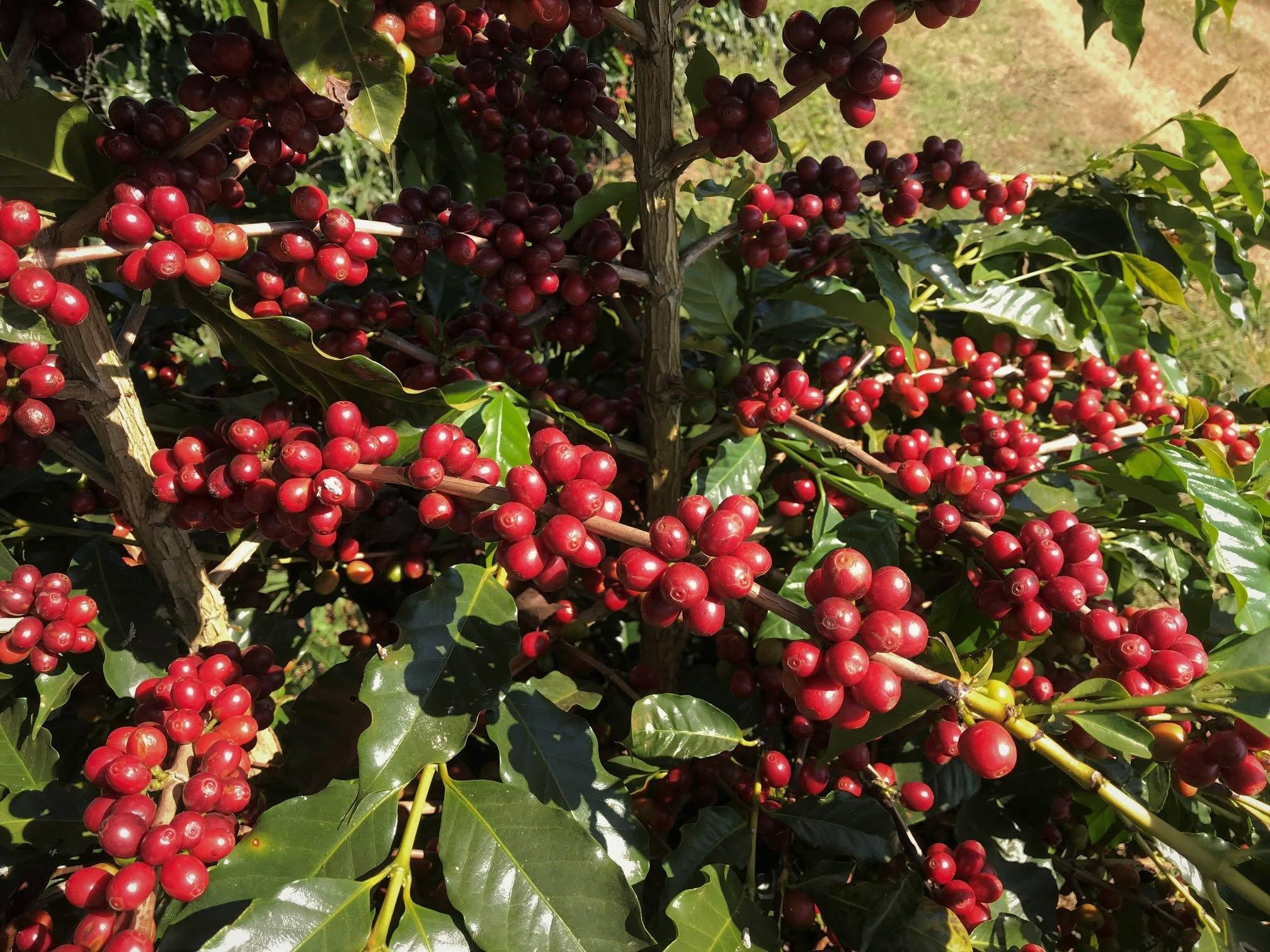
The coffee
Arabica grown from 2007 to today with one steady idea: good coffee starts with healthy soil.
A young crop on old land
For decades, Fazenda Movimento grew potatoes, run by Nelson Barbosa de Lima and his sons, Luiz Fernando and Nelson Luiz, known as Nelsinho. When potato prices fell and Nelsinho died in 1999, the farm turned to coffee: the decision came in 2007 and the first harvest in 2009.
The coffee fields cover the slopes that run down toward Lake Furnas, between 769 and 870 meters above sea level. The lake keeps humidity high all year, which favors fungi and calls for extra care with cup quality. Even so, most of the crop comes out with good quality.
Every tree has an origin and a record
The farm grows its own Coffea arabica seedlings from certified seeds, with technical supervision. The cultivars were chosen for how well they adapt to the climate of southern Minas Gerais.
- of coffee planted, after the frosts
- 72 ha
- coffee trees, approximately
- 350,000
- planted each season, from 2007 to 2013
- 18 ha
of coffee planted, after the frosts
coffee trees, approximately
planted each season, from 2007 to 2013
Before the frosts there were 107 ha and about 570,000 trees.
Cultivars
- Catuaí Vermelho
- Catuaí Amarelo
- Mundo Novo
- IAPAR
- Catucaí Vermelho
- Catucaí Amarelo 62
Traceability by plot
Each planting year forms a plot, and each plot has daily records. So every coffee lot can be traced back to the block and the day it was harvested.
- Mineral and organic fertilization
- Spraying
- Field management
- Harvest date and time
- Varieties
Where the coffee is born
The farm's coffee fields as a patchwork on the hills of southern Minas Gerais, with Lake Furnas behind.
Lots that tell the harvest
With selective harvesting and separation into microlots, the farm produces lots above 82 points, the threshold for specialty coffee. They have reached cafés in São Paulo, Brasília, Porto Alegre and Curitiba, and buyers in Europe, the United States and Korea.
From cherry to bag
Two hours, at most
Between picking and the washer, a load never waits longer than that, so the coffee does not ferment on its own and spoil the cup.
45% goes back to the field
Husks and mucilage removed during processing return to the field as organic fertilizer. With only 55% of the volume left to dry, drying time, dryer use and energy costs all go down.
Vacuum bags
The bulk bags are lined with plastic bags and the air is drawn out with a vacuum, to protect the beans from the lake's humidity.
Source: Agro DBO, “Sistema vencedor” (“Winning system”), April 2017.
Recognition
2013
1st place, Pulped Natural, southern Minas Gerais
10th Minas Gerais State Coffee Quality Contest, Emater-MG and UFLA. Lot entered by Alexandre do Nascimento, Fazenda Movimento.
2014
83.13 points at Semana Internacional do Café
Sample cupped by Q Graders from Academia do Café, in Belo Horizonte, and listed among the highest-scoring coffees in Brazil. Notes of star fruit and caramel.
Certification
Certifica Minas Café
Certification program of the Minas Gerais state government, with technical support from Emater-MG.
After the frost
In July 2019, and again in July 2021, frosts burned much of the coffee in southern Minas Gerais, and Fazenda Movimento was not spared. The trees were skeleton-pruned and stumped, and the crop was rebuilt from the trunk.
Two years of care later, the harvest came back, on a smaller area: the coffee went from 107 to 72 hectares, and from about 570,000 to 350,000 trees.
The plots that were not replanted now grow soybeans, beans and corn. There, the unpredictable climate keeps the risk of another burn high.
“I waited two years, tending, rebuilding... but it was worth it. As the old saying goes: you reap what you sow.”
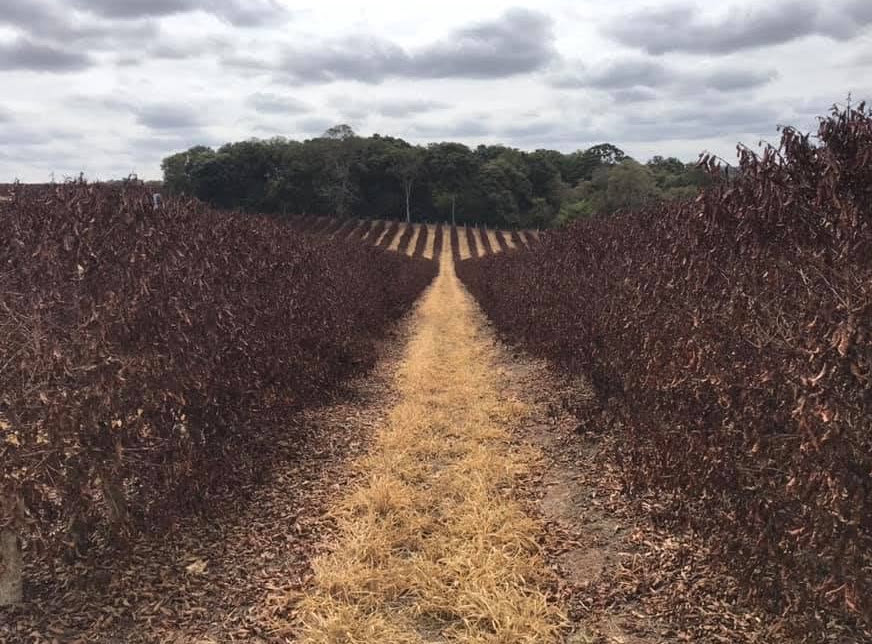 Before the frostAfter
Sources and documents
The figures and quotes on this page come from these documents. They are here for anyone who wants to check.
- “Sistema vencedor” (“Winning system”), Agro DBO magazineArticle by Rogério F. Furtado, April 2017, pp. 34–37. Source of the farming and post-harvest figures.PDF, 1.3 MB
- Cover crop guide, Emater-MGGuide to growing cover crops in agricultural production systems, with Fazenda Movimento as a reference.Emater-MG website
- Semana Internacional do Café score sheet, 2014Cupping by Academia do Café (Belo Horizonte), with a score of 83.13 points.Image, JPG
- Emater-MG and UFLA contest results, 201310th Minas Gerais State Coffee Quality Contest: 1st place Pulped Natural, southern Minas Gerais.UFLA website
- Minas Rural program, episode 932April 2014 report on the switch to coffee and the crop during the drought.Video, YouTube
- “The Time to Regenerate Coffee is Now, and it Starts with Healthy Soil”, Daily Coffee NewsArticle by Hugh Aprile (CRS), April 20, 2018, shared by the farm. Source of the idea of regenerative coffee and of the motto adapted to coffee.Daily Coffee News website
- Rodale InstituteThe institute's story: the Emmaus farm (1940), the founding of the Soil and Health Foundation (1947) and the motto “healthy soil, healthy food, healthy people”.Rodale Institute website